Austin Christian Southside (www.austinchristian.org) is a small church community of about 50 people at this writing that was planted by the larger Austin Christian Church and its downtown Tribe congregation in May of 2025. One year on, the church has about as many children as adults and one beloved member who has just begun hospice care.
Recently, it occurred to some of the young parents that if and when this member's hospice care ends in death, it would be the first time for many of the church's children to experience the loss of someone they know and love. I made this video as a beginning point for the adults of the congregation, to offer some resources and suggestions for how to talk about the difficult topic of death with children and to assist them in a healthy grieving process.
In this blog I’ve posted some resources related to this video. (They will probably make more sense if you watch the 7-minute video before reviewing the resources.)
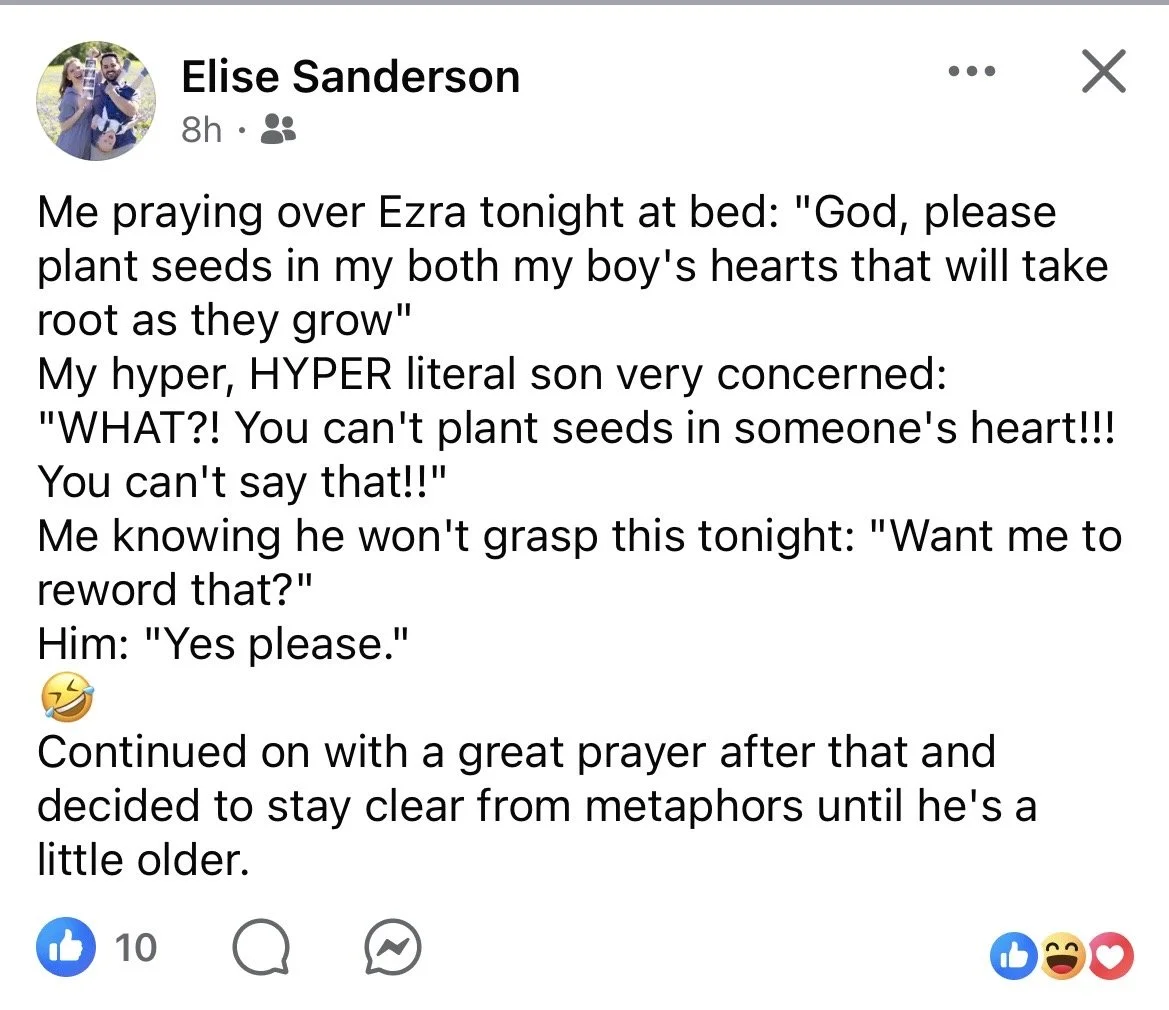
Elise Sanderson is the women’s minister for this church’s congregation. Her post, immediately below, came over my Instagram feed the same evening I was editing this video. A perfect present-moment illustration for the need to communicate in plain language with little children. Her oldest boy, Ezra, is three years old at the moment.
2. Following is an excerpt from the book, WHEN CHILDREN GRIEVE, by John James, Russell Friedman and Dr. Leslie Landon Matthews
Chapter 31: Euphemisms + Metaphors = Confusion
"For the next few moments this might seem like a high school English class. Sorry. Here are a few definitions from our worn but trusty Webster’s Ninth:
Euphemism—the substitution of an agreeable or inoffensive expression for one that may offend or suggest something unpleasant
Metaphor—a figure of speech in which a word or phrase literally denoting one kind of object or idea is used in place of another to suggest a likeness or analogy between them
Analogy—1. inference that if two or more things agree with one another in some respects, they will probably agree in others; 2. resemblance in some particulars between things otherwise unlike: similarity
Simile—figure of speech comparing two unlike things that is often introduced by like or as—as in “cheeks like roses” compare to metaphor
We don’t understand it a whole lot better now than we did in English class years ago. But we want to make a very serious point here. Little children are very literal. They do not grasp the idea that words do not mean exactly what they say. Euphemisms and metaphors, in particular, are baffling to children, and when it comes to death and other losses, their use can have profoundly negative effects on them.
The classic example is the child standing in front of Grandma’s casket being told, “Grandma’s sleeping,” whereupon that child is afraid to go to sleep for six months. As adults we understand that “sleep” is a metaphor for death; small children do not.
As we mentioned, children are very literal. As they begin to comprehend the world around them, they question everything. Almost any parent can recall the times when their little ones seemed to spend the entire day asking, “Why, Mommy?” or “Why, Daddy?” And, regardless of the answer, the child’s follow-up question is, “But why, Mommy?” They are trying to make sense of their world. It is very important to their survival. Later they will add poetry, symbolism, and metaphor. Don’t rush them and don’t confuse them.
Another very tricky area is the use of religious and spiritual metaphors concerning heaven. We cannot calculate the number of calls we have received over the years from concerned parents whose children wanted to “go to heaven” to find Grandpa. There are even the rare but real examples of children having committed suicide to accomplish the goal of being in heaven with someone they loved who had died.
And on this same topic, when children hear phrases like “Daddy went to be with Jesus,” there is a real danger that their literal interpretation can have unfortunate consequences. It is not uncommon for children to become angry with God or Jesus for taking away their loved one. We know of many people who never were able to complete the anger they felt as children, and who never established a loving relationship with God or any other religious principles. That is very sad, as they have been robbed of some of the potentially valuable benefits to be found in religious and spiritual sources.
Small children have a very hard time understanding things they cannot see or touch. Faced with an idea they cannot grasp, they will apply whatever they perceive about reality to that new idea. If Grandpa lives in the next town over, children know that we can get in the car and go visit Grandpa. If Grandpa has gone to heaven, that child’s mind says, “Okay, let’s get in the car and go visit Grandpa.” Most people allude to heaven being up above. Small children take that very literally, also. We have been told many times of children looking out of airplane windows, trying to find Grandpa.
Earlier, when introducing some of the ideas regarding religious and spiritual concepts, we used the word tricky. This is tricky territory because, whatever you believe, you probably hold those beliefs strongly and without reservation. We are in favor of strong beliefs; we have some very strong beliefs about what we think are the best ways to help children deal with loss. The question here is, How do you communicate your beliefs about heaven to your children without confusing them?
For the most part, the answer lies in simply making sure that one key phrase is included in your communication with the little ones. In response to your children’s questions, “Where’s Grandma?” or “What happened to Grandma?” try this: “Grandma has died. We believe that after someone has died, he or she goes to heaven.” The key phrase, which must be the first phrase, is “Grandma has died.” It must be the first phrase; if you start with “Grandma went to heaven,” your child will hear that and want to go there, and you may have a hard time saying, “But Grandma is dead, you can’t go there now.” Remember that little ones are completely literal.
Yes, you are liable to get a barrage of questions: What does died mean? What is heaven? Where is heaven? Who’s at heaven? Can we go there? But you can answer each of those in turn. We spent some time earlier in this section giving you some guidance on explaining death to your children. We are not saying that this is easy. Just be honest, and remember that you must be simple and concrete.
When it comes to beliefs about heaven and afterlife, there are many different perceptions. Some people perceive heaven in a very literal sense with people in flowing white robes, surrounded by beautiful, idyllic scenery. Others have a more metaphorical image. Still others have no belief in heaven, in any form, and believe that death signals the end of a being altogether. It is up to you to decide how much of what you believe you communicate to your child. Whatever you decide, be very clear about telling your children about death.
We will end this section by restating something we said a few pages ago:
Giving children accurate information about the reality of death does not interfere with the development of religious or spiritual beliefs about heaven and afterlife.
We hope that statement contributes to your ability to help your small children begin to understand death. Along with giving your children a clearer understanding of death, we encourage you to demonstrate the normal emotions that accompany the death of a loved one. Remember, your children look to you for guidance in all things. The factual reality of death is intellectual. The feelings attached to loss are emotional. The beliefs about what happens after this physical life ends are spiritual. We believe that all three are important."
James, John W., Russell Friedman, and Leslie Landon Matthews. When Children Grieve: For Adults to Help Children Deal with Death, Divorce, Pet Loss, Moving, and Other Losses. New York: HarperCollins, 2001. pp 230 -233.
3. For blogs, instruction, free ebooks on the topic of grief and loss and more on how to talk to children about death: click here for the website of the Grief Recovery Institute.
4. Debbie Banks is a Certified Grief Recovery Method® Specialist in the Austin area. She is available for questions and suggestions at her business mobile, 512-937-3233. You can reach me at tammy@missionstory.com and can find out more about my story with grief recovery if you’re interested here on my website.